

AI writes code.
We make sure it works.












Validation at the speed of generation






How it works


Built for how your team actually works


.svg)

.avif)

%20v2.avif)
One platform.
Every validation workflow.
.avif)





Agents are only as fast
as your validation loop

Frequently Asked Questions
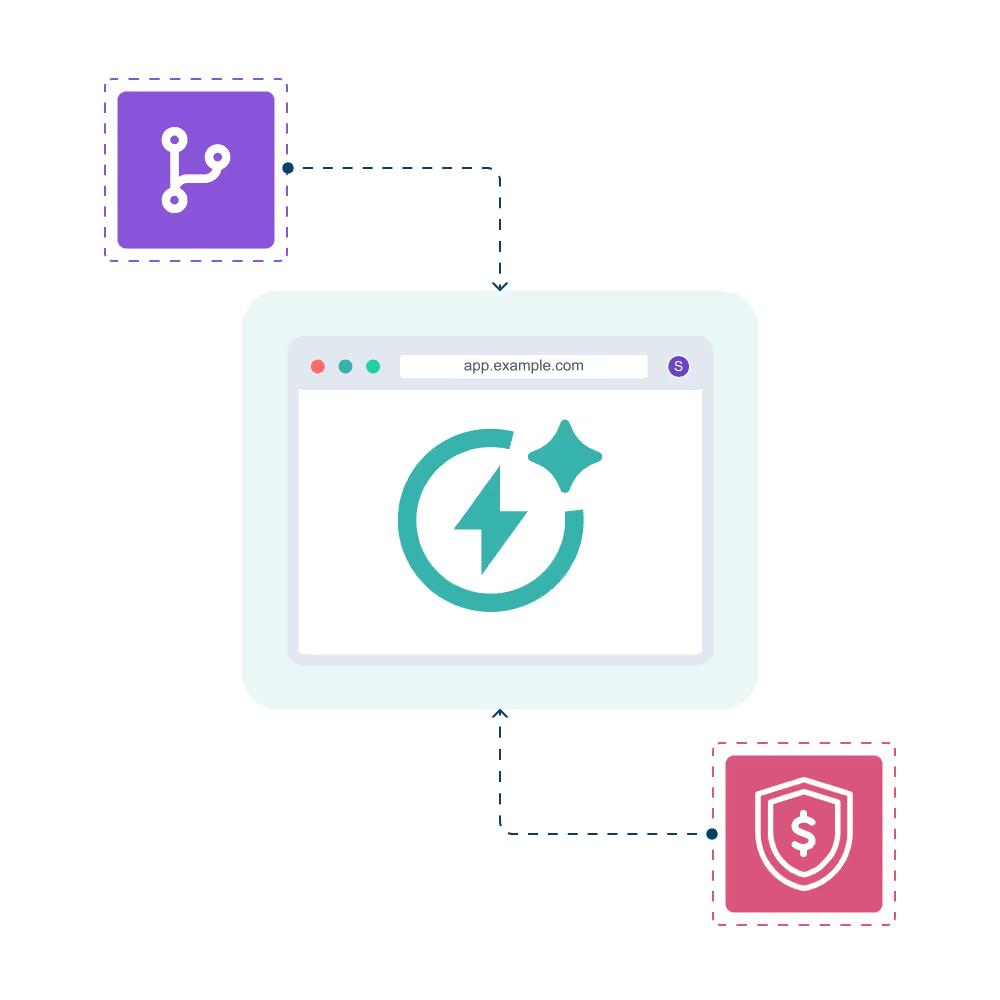
Unlike traditional ephemeral environment solutions that duplicate entire infrastructure stacks, Signadot uses a unique approach using sandboxes. This approach virtualizes environments within a single Kubernetes cluster by only duplicating the services needed, dynamically routing requests between the baseline and the sandbox. This allows you to efficiently run thousands of concurrent isolated environments for developers and agents without contention. Environments spin up in seconds, which is critical to enabling agentic workflows that demand fast feedback loops.
Signadot provides these core capabilities:
- Local Development: Connect local workstations, CDEs, or agent runtimes directly to your Kubernetes cluster via isolated sandboxes so agents can write, run, validate, and debug code against real dependencies and live traffic.
- Preview Environments: Automatically generate preview environments for every human or agent PR to validate changes from Web and Mobile frontends.
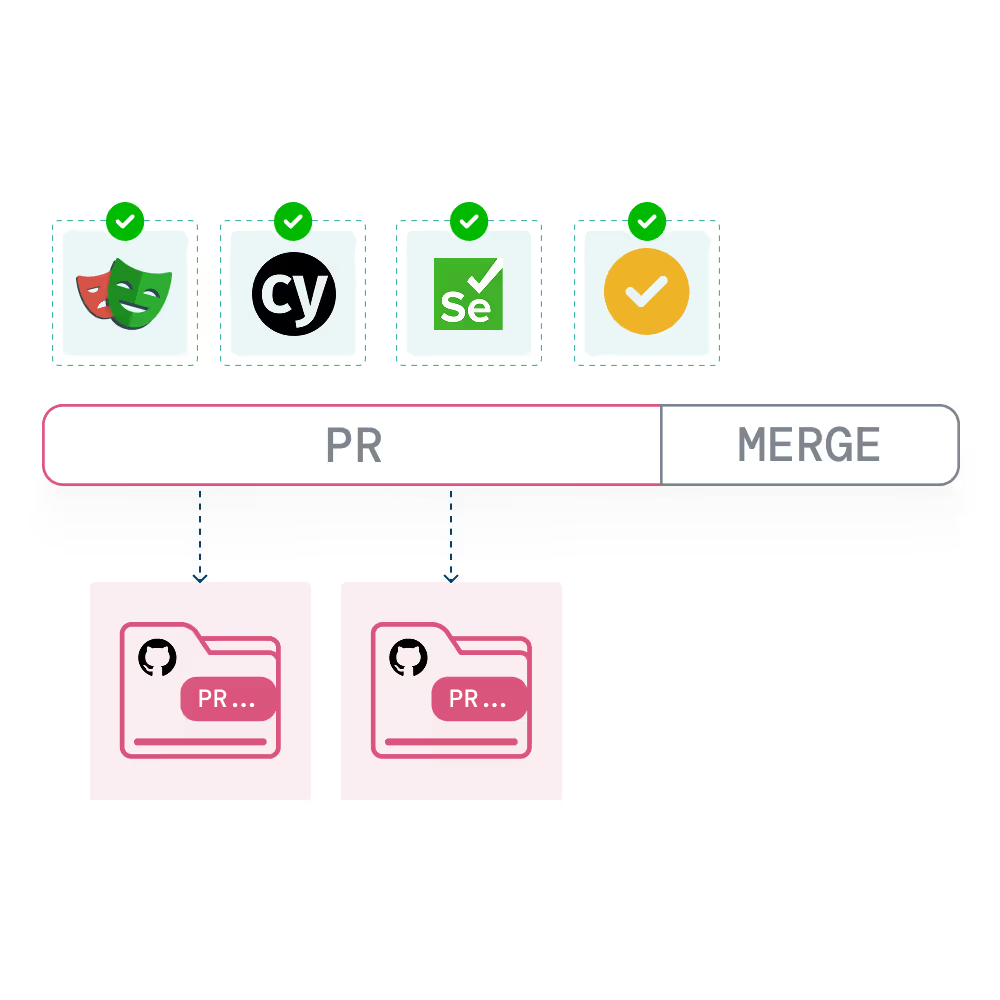
- Bring Your Own Automated Tests: Execute your K6, Playwright, Cypress, or other test suites against isolated sandboxes that are generated automatically for every PR.
- SmartTests: Validate PRs to catch regressions before merging with AI-powered auto-diff.
- Autonomous Workflows: Equip AI agents with the ability to provision sandboxes and validate their code autonomously via our MCP server
Signadot provides the runtime context and isolation required for agents to function as autonomous engineers. By connecting agent runtimes directly to your Kubernetes cluster via sandboxes, agents gain access to real dependencies and data without risking stability. This allows them to write code, run it against the live system, analyze errors, and self-correct in a tight feedback loop. Instead of just generating code, agents can deliver fully validated solutions that are ready to merge.
Signadot integrates natively with any tool that supports the Model Context Protocol (MCP), including Cursor, Claude Code, and VSCode. This allows your AI agents to provision sandboxes, route traffic, and verify code execution directly within their runtime, turning them into autonomous engineering partners that can validate their own work in a closed loop.
The Signadot MCP Server bridges the gap between your AI agents and your Kubernetes infrastructure. Using the Model Context Protocol standard, it exposes a set of native tools that allow agents to manage ephemeral environments and debug issues using natural language prompts. With the MCP server, coding agents can create and manage Signadot sandboxes and route groups, and fetch cluster context. This enables developers to integrate end-to-end validation with Signadot sandboxes into their autonomous workflows.
Sandboxes are lightweight, isolated testing environments that allow you to test changes without interfering with other developers or the base environment. Unlike traditional approaches that duplicate entire infrastructure, Sandboxes only create the specific components you're modifying and use request routing to provide isolation.
Sandboxes run inside your existing Kubernetes clusters. Signadot installs as an operator in your Kubernetes environment, so all workloads, data, and testing happen within your infrastructure. The Signadot control plane orchestrates the creation and management of these sandboxes, but your code and data never leave your environment.
Getting started with Signadot typically takes less than 15 mins. The minimal setup involves just two steps:
1. Installing the Signadot operator in your Kubernetes cluster.
2. Using our CLI to create Sandboxes and run tests.
Signadot integrates seamlessly with all major CI/CD systems through our CLI, which can be used as a step in your pipeline. This allows you to automate the creation of preview environments for every PR, ensuring that code generated by AI agents is automatically validated before it reaches a human reviewer. We have examples of integrations for GitHub Actions, GitLab CI, Jenkins, and BitBucket in our documentation.
Yes, Signadot works well with service meshes like Istio and Linkerd. While a service mesh is not required to use Signadot, we can leverage existing service mesh capabilities for header-based request routing.
Yes, Signadot provides robust support for automated testing. You can execute tests directly within your cluster, with support for all major testing frameworks including Cypress, Selenium, Playwright, Postman, and custom frameworks. Tests run in pre-warmed pods for faster execution, and results are aggregated in a central dashboard. This is critical for agentic workflows, where agents need immediate feedback from test results to self-correct.
SmartTests are AI-powered API tests that automatically detect breaking changes and contract violations. Written in a simple language called Starlark, they run in both your baseline and sandbox environments, comparing API responses to identify meaningful differences without requiring explicit assertions.
Security is a core principle in Signadot's design. Our architecture ensures your code and data remain within your infrastructure at all times. The Signadot control plane only receives metadata about tests and environments, never your actual code or sensitive data. We support RBAC for granular access control, and our system has undergone third-party security audits. Additionally, Signadot is SOC 2 Type II compliant, demonstrating our commitment to maintaining rigorous security standards.
Signadot supports cloud-native applications built using a microservices architecture running on Kubernetes. It is particularly valuable for teams with 10+ microservices, where testing becomes complex, and for organizations adopting AI coding agents that require high-velocity validation with concurrency for 50+ agents or developers. While it can work with any application that can run in Kubernetes, the benefits become more pronounced as your architecture grows in complexity.
Signadot offers flexible pricing based on the number of active Sandboxes and testing volume. We provide a free tier for small teams and startups, with paid plans scaling based on usage. For detailed pricing information and to find the plan that best fits your needs, please visit our pricing page or contact us for a custom quote.
Signadot complements rather than replaces these tools. While Playwright, Cypress, and Selenium focus on the mechanics of test execution (particularly for UI testing), Signadot provides the isolated environments where these tests can run. You can continue using your existing test frameworks, but run them against Signadot Sandboxes to achieve isolation and parallelism.


-p-1600.avif)


